All Eyes on Me: How the Spotlight Effect Quietly Destroys Your Child's Group Study Experience

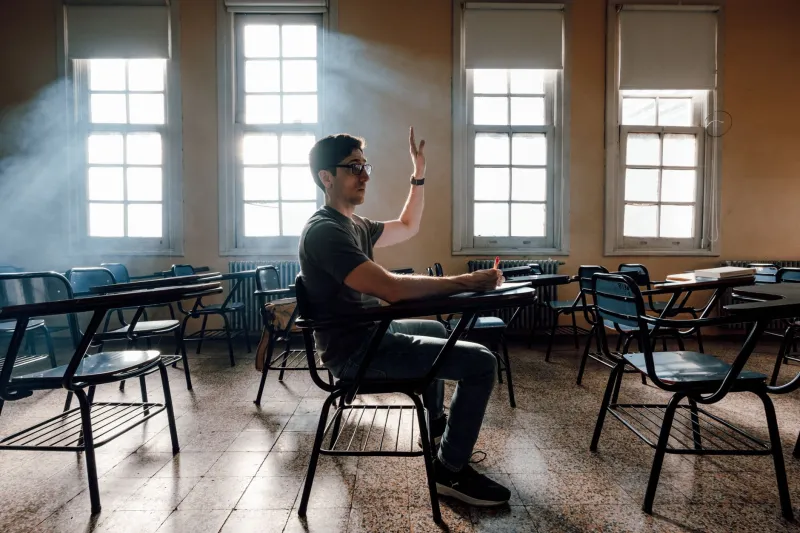
Picture this: a study group of five students gathered around a kitchen table, textbooks open, flashcards scattered across the surface. Four of them are debating the causes of the Civil War, bouncing ideas off one another with relative ease. The fifth student—perhaps your child—sits quietly, rehearsing a potential contribution in their head, second-guessing every word before it's spoken, and ultimately saying nothing at all.
From the outside, this student might appear disengaged or underprepared. In reality, they may be one of the most knowledgeable people in the room. What's holding them back isn't ignorance. It's the deeply human—and deeply misleading—belief that every person at that table is watching them, judging them, and waiting for them to stumble.
This is the spotlight effect in action. And in academic settings, it can do serious, lasting damage.
What the Spotlight Effect Actually Is
The spotlight effect is a well-documented cognitive bias, first formally studied by psychologists Thomas Gilovich and Kenneth Savitsky in the early 2000s. In simple terms, it describes the tendency for individuals to overestimate how much attention others are paying to their appearance, behavior, and mistakes.
In everyday life, this might mean your teenager is convinced that everyone at school noticed the small stain on their shirt. In an academic context, it manifests as the belief that a wrong answer in a study group will be remembered, judged, and discussed long after the session ends. The reality, supported consistently by research, is far less dramatic: other people are far too preoccupied with their own performance to spend meaningful mental energy scrutinizing yours.
But knowing that fact intellectually and feeling it are entirely different things—especially for adolescents, whose developing brains are already wired to be acutely sensitive to social evaluation.
Why Study Groups Amplify the Effect
Classrooms offer a kind of anonymity. A student can sit quietly in a row of twenty-five peers and avoid the spotlight with relative ease. Study groups strip that anonymity away. With five or six students around a table, there is nowhere to hide. Every hesitation is visible. Every blank expression is exposed. Every incorrect answer feels amplified.
For students who already carry social anxiety—a condition affecting roughly 15 percent of adolescents in the United States—this intimacy becomes a form of psychological threat. The brain's threat-detection system, the amygdala, doesn't distinguish between physical danger and social danger with particular sophistication. To a student in the grip of the spotlight effect, the risk of saying something wrong in front of peers can trigger a stress response that is physiologically similar to genuine fear.
When that happens, working memory narrows. Retrieval of learned material becomes harder. The student who studied diligently all week may suddenly struggle to articulate ideas they understood perfectly well the night before. This isn't a character flaw or a lack of effort. It is the predictable outcome of a brain operating under perceived threat.
The Avoidance Spiral That Follows
Perhaps the most damaging consequence of the spotlight effect in study settings is not what happens during the session—it's what happens afterward. Students who experience that kind of social stress tend to avoid the situations that triggered it. They decline future study group invitations. They opt for solitary studying even when collaborative review would genuinely serve them better. Over time, they miss out on one of the most effective learning strategies available: the act of explaining, debating, and teaching material to peers.
Research in cognitive science consistently shows that articulating knowledge aloud—sometimes called the protégé effect—dramatically strengthens retention and deepens understanding. Students who avoid group settings because of the spotlight effect are inadvertently depriving themselves of this benefit, compounding their academic disadvantage in ways that aren't always visible to parents or educators.
What Parents Can Do at Home
The first and most important step is creating space for your child to name what they're experiencing without judgment. Many students don't have the vocabulary to describe the spotlight effect; they simply know that study groups make them feel bad and that they'd rather avoid them. Asking open-ended questions—"What does it feel like when you're in a group and someone asks you a question?"—can open the door to a more honest conversation.
From there, parents can help by normalizing the experience. Sharing stories of your own moments of social self-consciousness, including how the feared judgment rarely materialized, can gently challenge the distorted belief that others are watching with critical eyes. The goal isn't to dismiss the feeling, but to offer perspective that gradually loosens its grip.
It can also help to practice low-stakes verbal explanation at home. Ask your child to teach you something they've learned recently. Let them stumble. Let them self-correct. The more comfortable they become with the imperfect articulation of knowledge in a safe environment, the less threatening it will feel to do so in front of peers.
How Tutors Can Build Psychologically Safe Learning Environments
At The Wise Owl Tutoring Center, we've seen firsthand how the quality of a student's learning environment shapes not just what they retain, but how willing they are to take the intellectual risks that genuine learning requires. Tutors play a critical role in dismantling the conditions that feed the spotlight effect.
One of the most effective approaches is modeling intellectual vulnerability. When a tutor openly acknowledges uncertainty—"That's a great question, and I want to think carefully before I answer"—it signals to the student that not knowing something immediately is not a failure. It's part of the process. That signal matters enormously to students who have been quietly catastrophizing their own knowledge gaps.
For students participating in small-group tutoring sessions, structured turn-taking can reduce the unpredictability that fuels anxiety. When students know in advance that they'll each have a designated moment to contribute, the element of being unexpectedly "put on the spot" diminishes. Over time, as trust within the group builds, those structures can be loosened, and more organic discussion becomes possible.
Tutors can also explicitly reframe mistakes as data rather than verdicts. A student who provides an incorrect answer in a session has just identified a gap worth addressing—that is genuinely useful information. Treating it as such, consistently and without drama, reshapes the emotional meaning of being wrong in a group context.
Reclaiming Group Learning as a Strength
The spotlight effect is a cognitive illusion, but its consequences are entirely real. Students who fall into its trap don't simply miss out on study group sessions—they miss out on the confidence that comes from discovering they can hold their own in academic conversation, that their ideas are worth sharing, and that a wrong answer is survivable.
Helping a student move through this particular barrier requires patience, consistency, and a willingness to look beneath the surface of their behavior. What appears to be disinterest in collaborative learning is often something far more nuanced: a student who cares deeply about how they're perceived, and who hasn't yet been shown that the audience they fear is far less attentive—and far more forgiving—than they imagine.
With the right support, that discovery is entirely within reach.